
The first 90 days after an autism diagnosis do not ask you to solve everything. They ask you to do a small number of things in a sensible order: understand what the evaluation found, get your paperwork into one place, start the services your child qualifies for, and build a few routines you can repeat without thinking about them. That is the whole assignment for three months.
I sit with Colorado families in the weeks right after a diagnosis, and the pattern repeats. A parent arrives holding a report they have read a dozen times and a mental list of forty things they believe they should already be doing. Most of those forty things can wait.
What follows is the roadmap we use at Achieve ABA Therapy Group, month by month, with the Colorado programs, phone numbers, and timelines that shape what is realistic here.
What the First 90 Days After an Autism Diagnosis Look Like
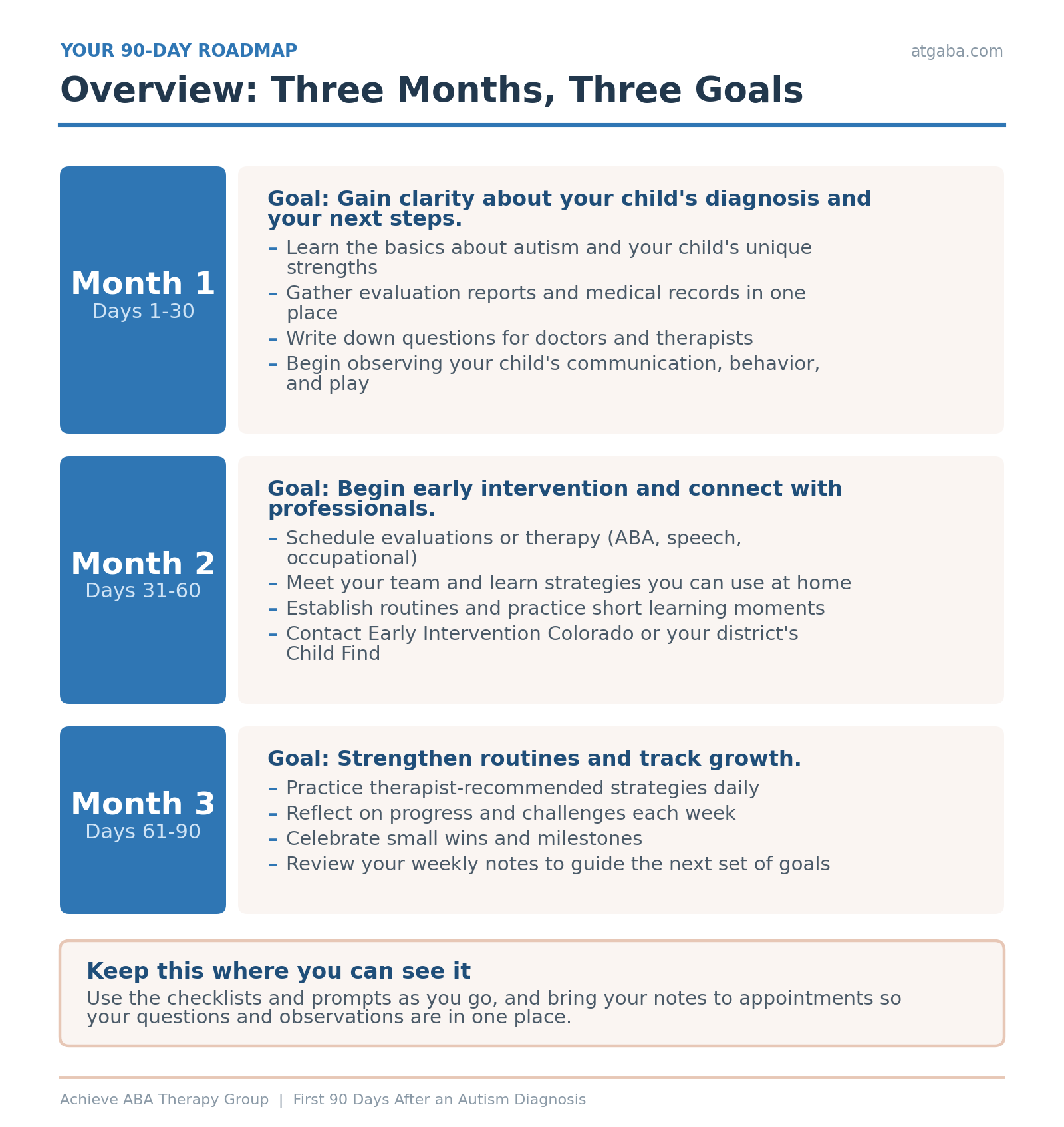
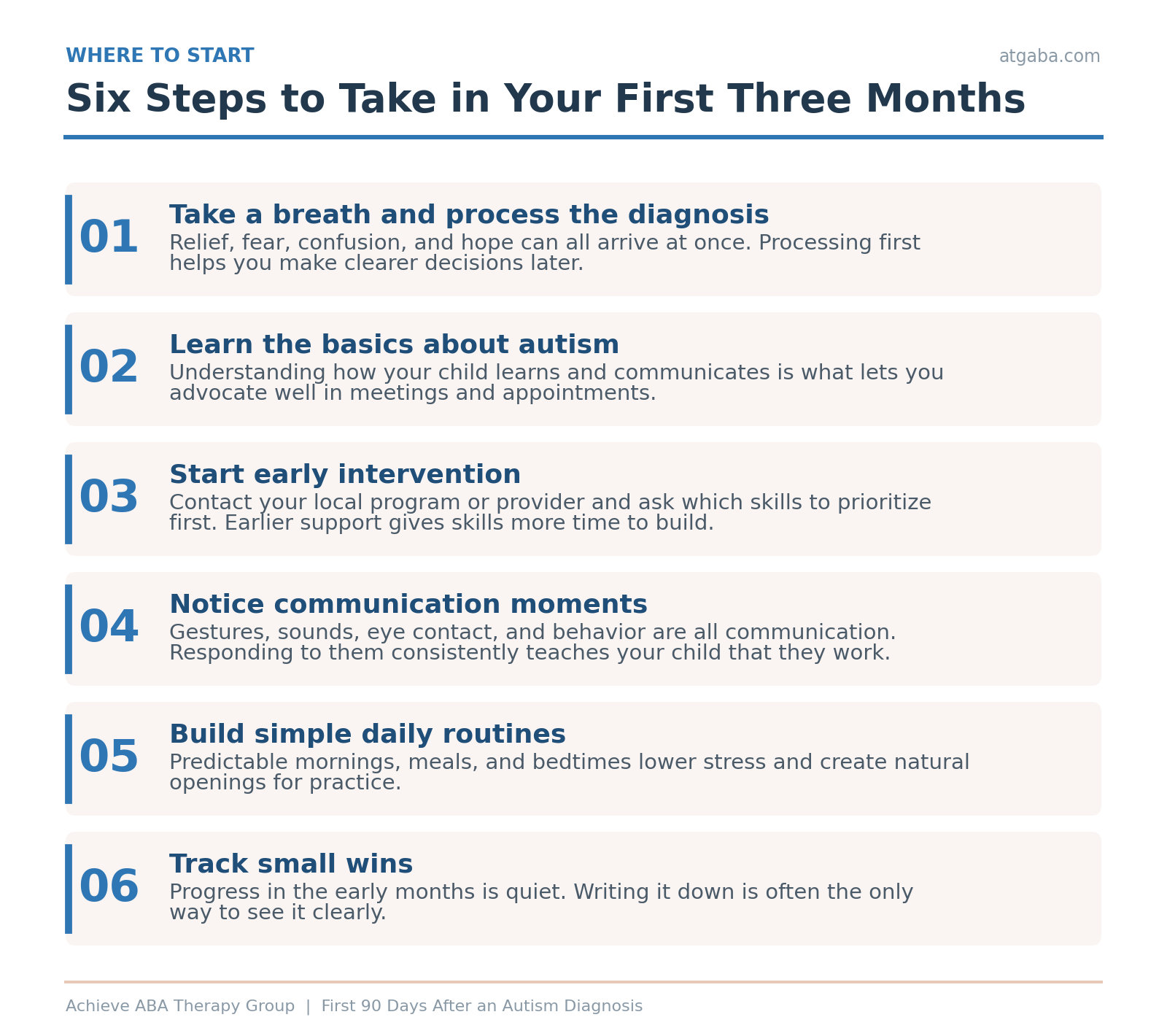
Three months sounds short when you are staring at an evaluation report. It is enough time to get oriented, get connected, and get a few things working at home. Splitting it into three one-month stretches keeps the list manageable.
Three months, three goals
Month one is for understanding and organizing. Month two is for building your team and starting services. Month three is for repetition, which is where new skills begin to hold.
Each month has one job. When a parent tells me they feel behind, it is usually because they are trying to do all three at once.
Why the order of the steps helps
Paperwork before phone calls saves you from repeating your child’s history to five different intake coordinators. Understanding your child’s strengths before setting goals keeps those goals tied to something real.
Starting simple routines before therapy begins gives your clinical team something to build on rather than something to untangle.
What can wait until later
You do not need to choose a school placement in week one. You do not need to read every book on autism, and you do not need a decision on every therapy that exists.
You also do not need to explain the diagnosis to extended family before you are ready. That conversation will still be available in three months.
Month 1: Understand the Diagnosis and Organize What You Have
The first thirty days are for information rather than action. The goal is that by day 30 you can describe your child’s profile in your own words and put your hands on any document within a minute.
Give yourself room to process the news
Relief, grief, fear, and a strange kind of clarity often arrive in the same week. Parents sometimes apologize to me for crying in a first meeting, which is never necessary.
Processing the diagnosis is a real task with a real payoff. Decisions made in a panic tend to be expensive and hard to reverse.
Read the evaluation report a second time, with a pen
Diagnostic reports are written for clinicians, and the useful parts are often buried in the middle. Circle the recommendations section, the standardized scores, and any sentence describing how your child communicates.
Write your questions in the margin as they come to you. If your child has not been evaluated yet, or you want a second opinion, our autism evaluation team can explain what the process involves and how long it usually takes.
Build one folder and keep everything in it
One physical folder, or one cloud folder, holding the evaluation report, pediatrician notes, insurance card, immunization records, prior therapy summaries, and the name and number of everyone you have spoken to.
You will be asked for these documents repeatedly over the next two months. Families who set this up in week one save themselves hours later.
Write down your child’s strengths first
Before you list what is hard, list what your child is good at and what they love. The things that hold their attention are the things we will use to teach.
One family I worked with in Fort Collins told me their son had no interests at all. Two weeks later we found he would work for twenty minutes straight if a ceiling fan was somewhere in the deal. That fan carried us through his entire first month of sessions.
Month 2: Build Your Child’s Support Team in Colorado
Days 31 to 60 are the connecting month. In Colorado, the door you knock on depends almost entirely on your child’s age, and the timelines are set in state and federal rule rather than by any individual provider.
Start with Early Intervention Colorado if your child is under three
Early Intervention Colorado is the state’s Part C program. Since July 2022 it has been run by the Colorado Department of Early Childhood rather than the Department of Human Services. You can refer your own child by calling 1-888-777-4041, and no physician referral is required.
Children generally qualify with a measured delay of at least 25 percent in one or more developmental areas, or with a diagnosed condition likely to lead to a significant delay. After a referral, the evaluation, family assessment, and Individualized Family Service Plan should be completed within 45 days.
There are no family fees for services listed on the IFSP and no income test to participate. We cover eligibility and cost in more detail in our guide to early intervention Colorado, and our early intervention ABA program is built for children in this age range.
Go through Child Find if your child is three to five
At the third birthday, responsibility shifts from Part C to the public school system. Referrals for children ages three through five go to the Child Find team in the Special Education Administrative Unit where you live, which may be your school district or a BOCES.
Once you sign written consent, the initial evaluation and eligibility meeting should be completed within 60 calendar days. If your child is found eligible, the team writes an Individualized Education Program instead of an IFSP.
The Colorado Department of Education keeps a Child Find contact directory organized by region, which saves a lot of phone tag. Once an IEP is in place, our support in the classroom can run alongside it in partnership with your child’s teachers.
Understand how ABA is paid for in Colorado
Two separate systems apply here, and which one you are in changes your options. Under C.R.S. 10-16-104, state-regulated health plans issued or renewed in Colorado must cover the assessment, diagnosis, and treatment of autism spectrum disorder, including applied behavior analysis.
Senate Bill 15-015 folded autism into the state’s mental health parity requirements effective January 2017, which removed the age and dollar caps that used to apply.
That mandate reaches only fully insured plans regulated by the Colorado Division of Insurance. Self-funded employer plans fall under federal ERISA law and are not required to follow it, though many choose to mirror it. Coverage still depends on medical necessity and the specific language in your plan documents.
For families on Health First Colorado, ABA sits within the Pediatric Behavioral Therapies benefit for members 20 and younger who meet EPSDT medical necessity criteria, and every service requires prior authorization. Our insurance team verifies benefits before a first session, and we break down carrier specifics in our post on ABA insurance coverage.
Decide where therapy will happen
Setting is a clinical decision as much as a logistical one. Skills taught in the place where they are needed tend to transfer more reliably than skills taught in an unfamiliar room.
Most of our work happens through in-home sessions, since that is where mealtimes, transitions, and bedtime routines happen. We also support children in daycare settings and in group home environments when that is the right fit.
For working parents in Denver, Aurora, and Lakewood, Saturday and Sunday sessions often make the schedule workable when weekday hours will not stretch.
Questions worth asking any provider
Ask these of us and of everyone else you are considering. The answers tell you more than a website will.
- Who will be in my home each week, and how often does a BCBA supervise them?
- How many hours are you recommending, and what is that number based on?
- How will you measure progress, and how often will I see the data?
- What happens if my child is not making progress after three months?
- How will you involve me in sessions rather than around them?
Our own answers are laid out on the how it works page. A provider who cannot answer the fourth question clearly should give you pause.
Month 3: Turn New Strategies Into Ordinary Routines
By day 60 you have a plan and a team. Days 61 to 90 are about repetition, which is unglamorous and also where most of the early progress comes from.
Practice inside the routines you already have
You do not need to add practice time to your day. Handwashing, getting into the car, and putting on shoes are already happening, and each one holds a dozen teaching opportunities.
Five deliberate minutes at breakfast, repeated daily, tends to produce more change than an hour of drills on a Saturday. This is the center of our parent training work, and the piece parents most often tell us made the biggest difference.
Keep the order of the day predictable
Predictability lowers the cost of every transition. When your child knows what follows what, the energy they were spending on uncertainty becomes available for learning.
Same order, same words, same signal that an activity is ending. A two-minute warning and a visual timer are ordinary tools that do a surprising amount of work.
Sleep is often the first thing to improve once routines stabilize, and it deserves attention early, since a tired child learns less. We wrote separately about sleep and autism for families in exactly this position.
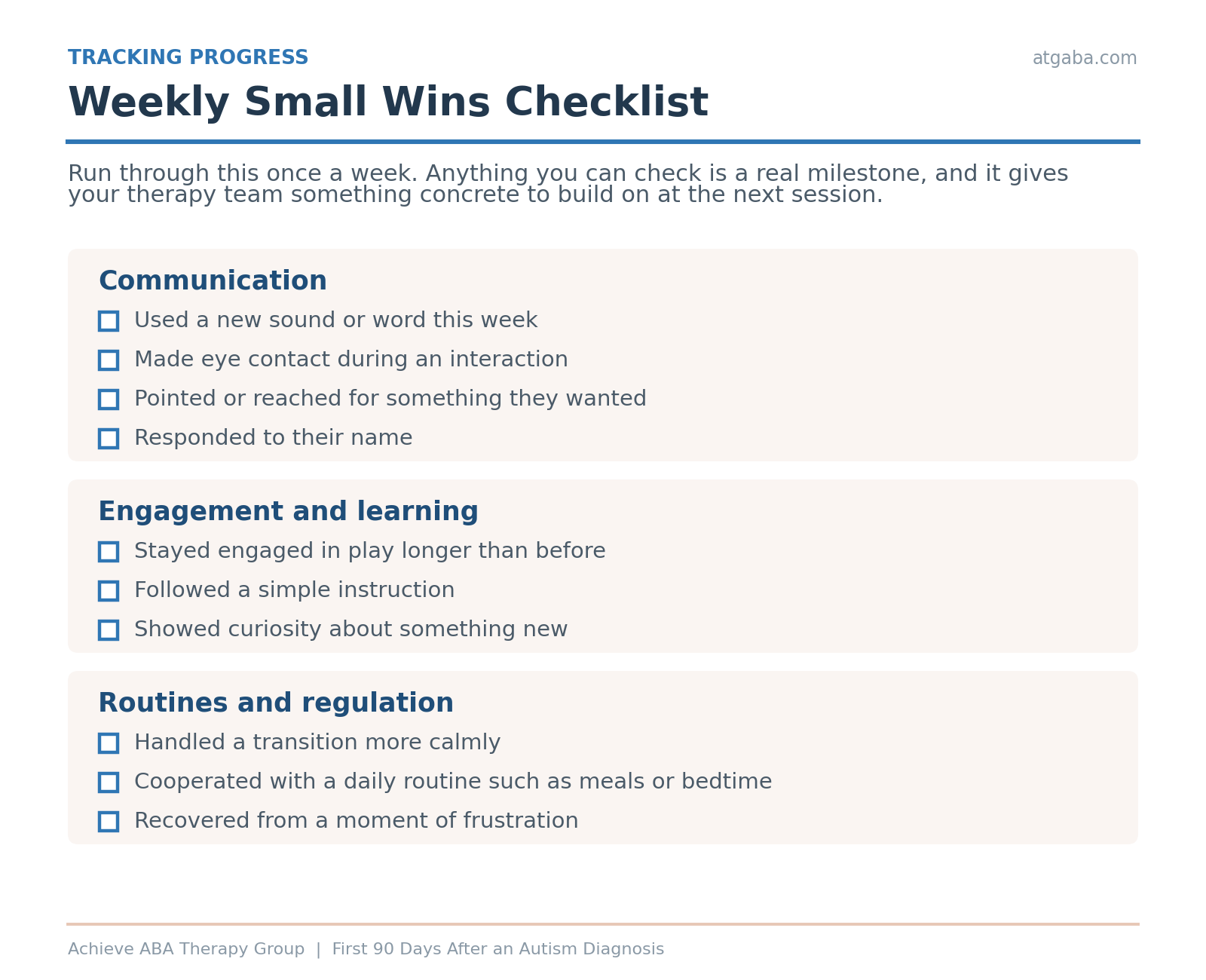
Track small wins so progress becomes visible
Progress in the first 90 days is quiet. A child who tolerates a transition without escalating has done something significant, and from the outside it looks like nothing happened.
Write it down anyway. Parents who track consistently are far less likely to conclude that nothing is working, because they have evidence in front of them.
Reading Your Child’s Communication Before Words Arrive
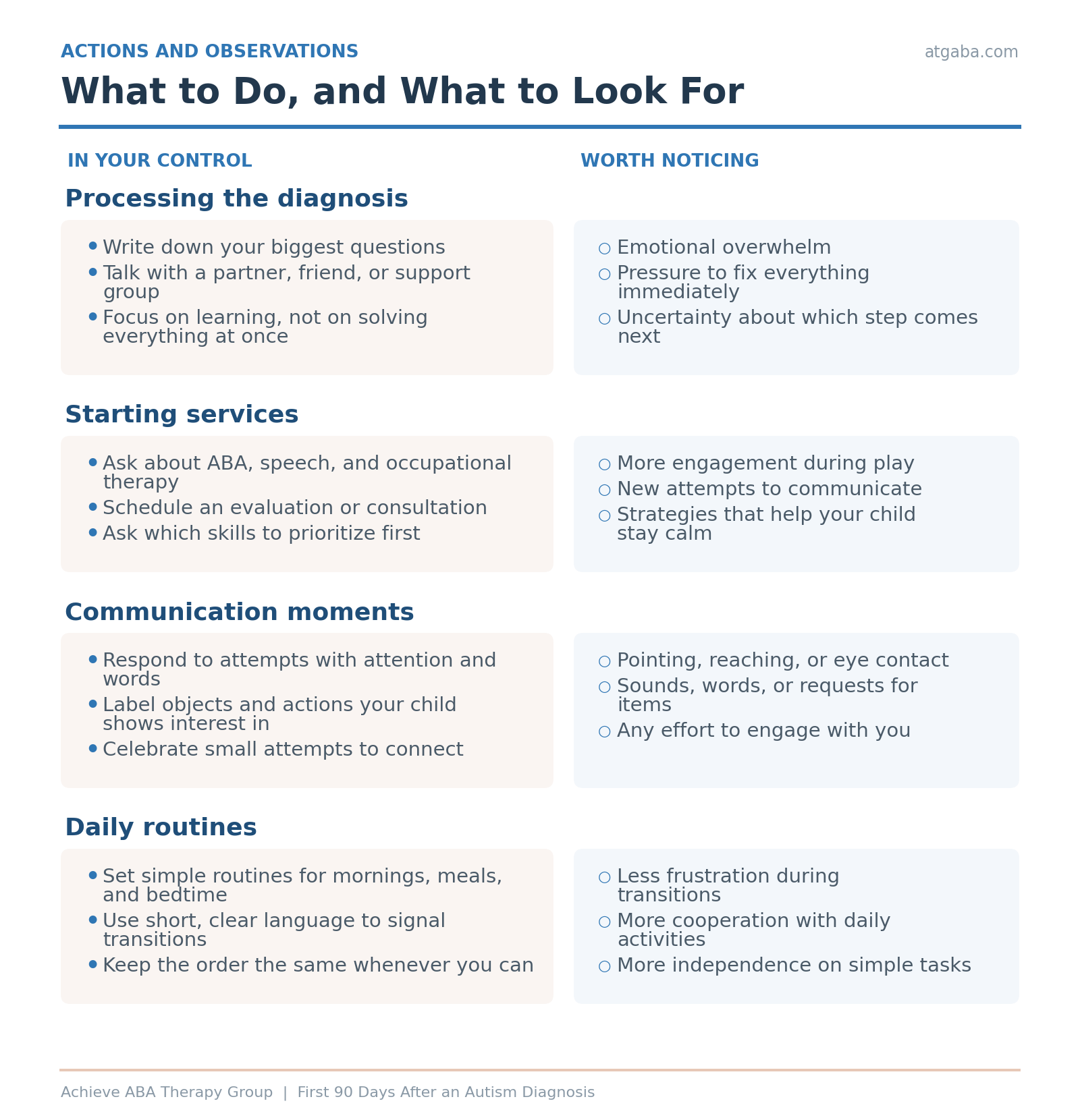
Communication and speech are two different things. Long before words appear, children signal wants, discomfort, and interest, and those signals are the foundation everything else gets built on.
What counts as a communication attempt
A reach toward the counter. A hand on your wrist. A sound made while looking at a cup. Being led by the hand to the pantry door.
Even behavior that looks like a problem is frequently a request with no better route available. When we assess a child, one of the first questions is what the behavior is accomplishing. A child who screams at a closed fridge is communicating clearly, just not conveniently.
How we respond in session
We respond to the attempt, then shape it toward something that works better. If a child pulls my hand to the door, I might pause, hold up the picture of outside, and wait two seconds before opening it.
The wait is the teaching. Responding instantly removes the reason to try something new, and waiting too long turns a learning moment into a standoff.
When picture systems or devices come in
Some children need a bridge while speech develops, and some need a long-term alternative. Research has generally found that picture systems and speech-generating devices do not slow speech development, and in many cases support it. If your child has few words at three, this is a conversation worth starting early rather than after another year of waiting. Our overview of picture exchange systems explains how the process usually begins.
The Weekly Habit That Makes Appointments More Useful
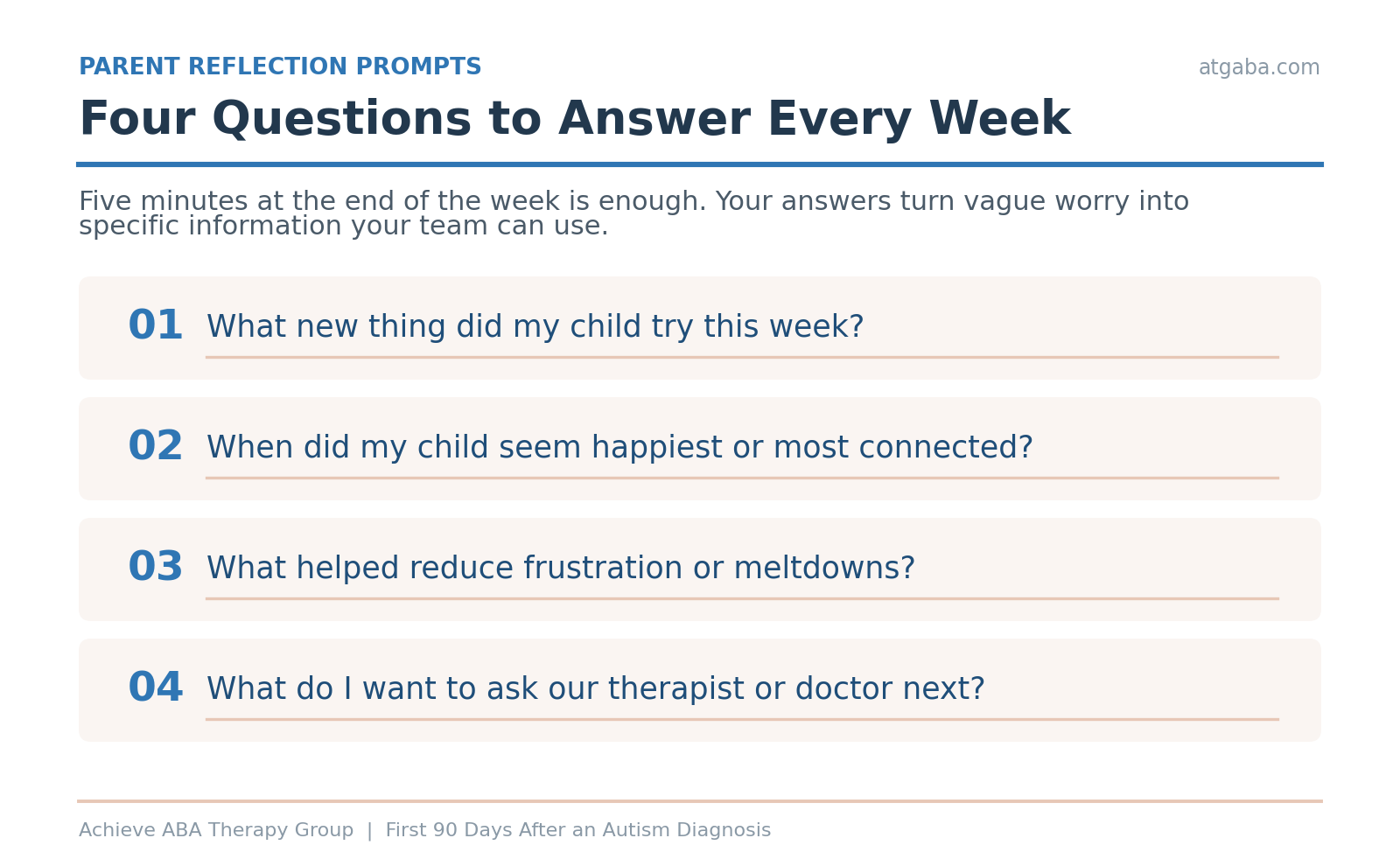
Short appointments reward preparation. A brief weekly reflection turns a month of vague impressions into specific information your team can act on.
Four questions to answer each week
Answer these on Sunday night, or whenever your week ends. Five minutes is enough, and the answers do not need to be tidy.
How your notes change what we work on
When a parent tells me their child had a hard week, I have very little to work with. When they tell me the hard moments clustered on the two mornings the schedule changed, we have a target.
Patterns show up in writing that memory smooths over. Several times a year a parent’s notes have redirected a treatment plan more usefully than my own session data, because they see the twenty-three hours a day that I do not.
What Realistic Progress Looks Like by Day 90
This is where I try to be careful, because the honest answer varies a great deal between children. Ninety days is early, and the range of normal is wide.
Early signs we watch for
- More attempts to communicate, even when they are not yet words
- Shorter recovery time after frustration
- Longer stretches of shared attention during play
- Fewer escalations around predictable transitions
- More willingness to try something new with a familiar adult nearby
These are early indicators rather than outcomes. Larger changes in language and independence usually take longer, and the pace differs between children in ways nobody can predict at the start.
Why comparisons to other children mislead
You will meet a parent whose child began speaking in sentences after four months. You will meet another whose child worked on a single request for the better part of a year.
Both are real, and neither tells you anything about your child. The comparison worth making is your child in month three against your child in month one.
When to raise a concern with your team
If you cannot see any change by the end of the first three months, say so plainly. A good clinical team should welcome the question and be able to show you the data behind their answer.
Ask what has been tried, what the data show, and what would change if progress stayed flat for another month. A plan that never changes is not a plan.
Colorado Programs and Organizations Worth Knowing
Colorado has a reasonably dense support network, though it is not always easy to find from a search bar. These are the ones families come back to.
State programs and who runs them
- Early Intervention Colorado, run by the Colorado Department of Early Childhood, for children from birth to their third birthday. Referrals go through 1-888-777-4041 or the CDEC contact page.
- Child Find, run through school districts and BOCES under the Colorado Department of Education, for children three and older.
- Health First Colorado, administered by HCPF, which covers behavioral therapy for children and youth 20 and younger who meet EPSDT criteria.
One caveat on statistics you will run across: Colorado is not one of the 16 sites in the CDC’s monitoring network, so there is no state-level prevalence figure for Colorado. The national estimate is about 1 in 31 eight-year-olds identified with autism in 2022.
Parent advocacy and community support
PEAK Parent Center in Colorado Springs is the state’s federally designated Parent Training and Information Center, and can help you prepare for an IEP meeting at no cost. You can reach them at 719-531-9400 or through their resource library. The Colorado Department of Education also publishes a referral resource page for families new to the process.
Autism Society of Colorado, Firefly Autism in Lakewood, and JFK Partners at the University of Colorado each run programs Colorado families use regularly. Community Centered Boards, of which Colorado has 20, handle service coordination and access to Medicaid waivers.
Talk to the parents in your child’s waiting room too. Local knowledge about which providers in Colorado Springs or Pueblo currently have openings is usually more current than anything published.
Where we fit in
We provide in-home and community-based ABA across the Front Range and beyond, with teams serving families in Thornton, Arvada, Westminster, Centennial, and Boulder. The full list of communities we cover is on our locations page.
If you are somewhere inside these first three months and want to talk it through with someone who does this daily, reach out to our team. We will tell you honestly whether ABA is the right next step for your child, including when the answer is not yet.
Frequently Asked Questions About the First 90 Days
How soon should ABA therapy start after an autism diagnosis?
Sooner is generally better, though there is no single deadline. Most families begin somewhere between four and twelve weeks after diagnosis, and the delay is usually paperwork rather than clinical debate. Starting the insurance verification and intake process early is what shortens that gap, since authorization often takes longer than scheduling does.
Do I need a formal autism diagnosis before starting ABA in Colorado?
For insurance-funded ABA, a diagnosis and a documented treatment plan are usually required. Some services, including early intervention through the state and certain school-based supports, do not require an autism diagnosis and instead depend on a documented delay. If you are still waiting on an evaluation, ask about what can begin in the meantime.
How many hours of ABA does my child need?
That depends on your child’s age, goals, and how they respond, and it should come from an assessment rather than a formula. Recommendations commonly range from a few hours a week to twenty-five or more for young children with intensive goals. Any provider recommending a specific number before assessing your child is guessing.
Will insurance cover ABA therapy in Colorado?
Many plans do. State-regulated plans in Colorado are required to cover autism treatment including ABA under C.R.S. 10-16-104, and Health First Colorado covers it for members 20 and younger who meet EPSDT medical necessity criteria. Self-funded employer plans are governed by federal law and are not bound by the state mandate, so coverage varies. Checking your specific plan is the only reliable answer.
What happens if my child is about to turn three?
Transition planning from early intervention to preschool special education should begin well before the third birthday, and a referral is typically made to your school district’s Child Find team in advance. If a child is referred to Part C fewer than 45 days before turning three, the referral generally goes directly to the district instead. It is worth asking your service coordinator about this timeline early.
Can my child receive ABA and speech therapy at the same time?
Yes, and many children do. The two disciplines address overlapping goals from different angles, and coordination between them tends to improve both. Ask each provider how they plan to communicate with the other so goals reinforce rather than duplicate each other.
How do I know whether a provider is qualified?
Look for a Board Certified Behavior Analyst overseeing the treatment plan and registered behavior technicians delivering direct services under supervision. Ask about the supervision ratio, staff turnover, and how often the BCBA is present in sessions. Credentials are verifiable through the Behavior Analyst Certification Board’s public registry.
What if I am not ready to start anything yet?
That is a legitimate position, and it is worth saying out loud to your team rather than quietly missing appointments. There is a difference between pausing deliberately and drifting. If it helps, start with a single step, such as making the early intervention referral, and revisit the rest in a few weeks.
Sources:
- Centers for Disease Control and Prevention. (2025, April 15). Prevalence and early identification of autism spectrum disorder among children aged 4 and 8 years — Autism and Developmental Disabilities Monitoring Network, 16 sites, United States, 2022. Morbidity and Mortality Weekly Report, Surveillance Summaries, 74(2). https://www.cdc.gov/mmwr/volumes/74/ss/ss7402a1.htm
- Centers for Disease Control and Prevention. (2025, May 27). Data and statistics on autism spectrum disorder. https://www.cdc.gov/autism/data-research/index.html
- Centers for Disease Control and Prevention. (2025, May 28). ADDM Network sites. https://www.cdc.gov/autism/addm-network/sites.html
- Colorado Department of Early Childhood. (n.d.-a). Contact us. Retrieved September 2, 2026. https://cdec.colorado.gov/resources/contact-us
- Colorado Department of Early Childhood. (n.d.-b). Early intervention for infants and toddlers with developmental delays. Retrieved September 2, 2026. https://cdec.colorado.gov/early-intervention-for-infants-and-toddlers
- Colorado Department of Education. (n.d.-a). Colorado Child Find contact directory. Retrieved September 2, 2026. https://ed.cde.state.co.us/cdesped/childfindpreschoolsped/child-find-for-children-ages-3-through-5-years-old/child-find-directory-for-children-ages-3-through-5-years-old
- Colorado Department of Education. (n.d.-b). Referral for special education evaluation in Colorado. Retrieved September 2, 2026. https://www.cde.state.co.us/cdesped/referralresourcefamilies
- Colorado Department of Education. (n.d.-c). The child identification guidelines. Retrieved September 2, 2026. https://www.cde.state.co.us/cdesped/childidguidelines
- Colorado Department of Education. (2026, July 2). Child Find for children ages 3 through 5 years old. https://ed.cde.state.co.us/cdesped/childfindpreschoolsped/child-find-for-children-ages-3-through-5-years-old
- Colorado Department of Health Care Policy and Financing. (n.d.-a). Children and youth behavioral health. Retrieved September 2, 2026. https://hcpf.colorado.gov/childrenandyouth
- Colorado Department of Health Care Policy and Financing. (n.d.-b). Pediatric behavioral therapies information for providers. Retrieved September 2, 2026. https://hcpf.colorado.gov/pediatric-behavioral-therapies-information-providers
- Colorado General Assembly, Legislative Council Staff. (2020, March 9). Colorado health insurance mandates (Memorandum R20-238). https://content.leg.colorado.gov/sites/default/files/r20-238_health_insurance_mandates_0.pdf
- Mandatory coverage provisions — definitions — rules — applicability, Colo. Rev. Stat. § 10-16-104 (2024).
- PEAK Parent Center. (2026, January 6). Early childhood resource library. https://www.peakparent.org/content/early-childhood-resource-library/