
A child may learn a skill during therapy, but the bigger goal is being able to use that skill throughout the day. Home, school, daycare, and community settings all come with different routines, expectations, and opportunities to practice.
That is why flexibility can matter when choosing an ABA provider. Some children may benefit from in-home support, while others may need help in the classroom, at daycare, or out in the community. Parent training can also help families reinforce progress between sessions.
Looking at the strengths of each setting can help families understand what kind of support may fit best and why ABA therapy in multiple settings can make skill generalization more natural. At Achieve ABA Therapy Group, our approach is built around meeting children where life is already happening.
Important Things to Look for When Choosing an ABA Provider
ABA services can vary significantly by provider, location, clinical model, insurance authorization, and the needs of each child. Before enrolling, ask where therapy can take place, how transitions between settings are handled, how caregivers and teachers are included, and whether the provider can adapt when a child’s routine changes.
For example, a preschooler may benefit from support at home and daycare, while a school-age child may need stronger coordination between home and school. A family navigating a new school year may also want back-to-school support, while a younger child may be a good fit for early intervention services.
Questions to Ask About Flexible ABA Services
| Ask about | Why it matters | How Achieve approaches it in Colorado |
| In-home availability | Lets goals be practiced inside real family routines. | We provide in-home care across Colorado and build goals around everyday life. |
| School coordination | Helps skills carry into lessons, transitions, recess, and peer interactions. | We offer school-based services and coordinate care around the school day when permitted and clinically appropriate. |
| Daycare support | Creates opportunities to work on group routines, play, and communication where young children spend time. | We offer daycare-based care and can partner with daycare teams as part of the treatment plan. |
| Structured or center-based options | Some children and families prefer a dedicated clinic environment. | Our current Colorado model emphasizes natural-setting care, with no clinic visits required. Families should ask whether that model matches their needs. |
| Community skill practice | Real-world settings can help turn learned skills into functional everyday behavior. | We focus on goals that matter in daily life. Specific community-based activities should be confirmed with the care team because availability can vary by plan and location. |
| Parent training and support | Caregivers help create consistency between therapy sessions. | Parent training is part of our broader support model, helping families use practical strategies in everyday routines. |
Information may vary by provider and location. Service availability can also depend on clinical need, insurance authorization, permissions from schools or daycares, staffing, and the individual treatment plan.
In-Home ABA Therapy: Building Skills Inside Everyday Routines
In-home ABA therapy brings treatment into the environment a child knows best. Sessions can focus on communication, daily living skills, transitions, play, emotional regulation, or other individualized goals within the routines that already shape the family’s day.
Who In-Home ABA Therapy Can Help
This setting can be especially helpful for children whose most important goals are tied to mornings, meals, toileting, sibling interactions, homework, bedtime, or other home-based routines. It also gives clinicians a clearer view of the real cues, distractions, and supports that influence behavior at home.
Why Home-Based Practice Supports Skill Generalization
For generalization, the advantage is practical: a skill is being taught in the same place where the child will need to use it. When caregivers learn the same strategies, there are more opportunities to reinforce progress between sessions instead of limiting practice to therapy hours.
School-Based ABA Therapy: Supporting Learning, Transitions, and Independence
School-based ABA therapy places support inside the school day, where expectations can shift quickly between instruction, independent work, transitions, lunch, recess, and peer interaction. The goal is not to replace teachers or school supports, but to help a child participate more successfully in the environment where they spend a large part of the week.
Who School-Based ABA Therapy Can Help
It can be a strong fit for children working on classroom participation, flexibility, communication, organization, peer skills, or greater independence with school routines. When therapists and educators can coordinate appropriately, the child receives more consistent cues and expectations across the day.
Why the School Setting Supports Skill Generalization
School is also an important place to test whether a skill learned elsewhere is truly portable. If a child can use a coping strategy with a teacher, ask for help during a difficult assignment, or navigate a transition with less prompting, that is meaningful generalization in action.
Daycare-Based ABA Therapy: Practicing Social and Group Skills Where They Happen
Daycare-based ABA therapy supports children inside a setting filled with natural opportunities for play, communication, waiting, sharing, transitions, and group participation. Rather than practicing those skills only one-on-one, the child can work on them in the flow of a typical daycare day.
Who Daycare-Based ABA Therapy Can Help
This setting may be especially useful for preschoolers and young children who spend regular time in childcare and need support with circle time, snack, peer play, following group directions, or moving between activities. It can also reduce the disconnect between what a child can do in a therapy session and what they can manage in a busy group environment.
Why Daycare Routines Support Skill Generalization
Skill generalization matters here because daycare naturally includes different adults, peers, materials, and routines. Using a skill across those variations can help it become more flexible and functional instead of tied to one therapist or one room.
Center-Based ABA Therapy: When a Structured Clinic Setting May Fit
Center-based ABA therapy takes place in a dedicated clinic or treatment center. For some children, that structured environment can make it easier to control distractions, access specialized materials, create repeated teaching opportunities, or participate in programs that are easier to organize in one location.
Who Center-Based ABA Therapy May Fit and How to Plan for Generalization
It may be a good fit for families who prefer a consistent therapy site or for goals that benefit from a highly structured learning environment. The key question is what happens next: families should ask how skills learned in a center are practiced at home, school, daycare, and other real-life settings so progress does not remain tied to the clinic.
How Achieve Approaches Service Settings in Colorado
Achieve’s current Colorado service model emphasizes bringing care into natural environments, including home, school, daycare, and group-home settings, rather than requiring clinic visits. If your family specifically wants center-based ABA therapy, ask about setting options during intake so you can choose a model that fits your priorities.
Community-Based ABA Therapy: Turning Skills Into Everyday Independence
Community-based ABA therapy focuses on using skills in places beyond home, school, or daycare. Depending on a child’s age and treatment goals, this might involve practicing safety, waiting, communication, transitions, shopping routines, recreation, or other functional skills in everyday community environments.
Who Community-Based ABA Therapy Can Help
This kind of practice can be especially valuable when a child can demonstrate a skill in a familiar setting but has difficulty using it around new people, new sensory demands, or less predictable routines. Community practice gives the care team a chance to see what changes outside the usual therapy environment and to adjust supports accordingly.
How Community Practice Supports Real-World Generalization
At Achieve, we focus on skills that are useful in daily life and coordinate care across the environments we serve. Practicing with different people, routines, and community cues can help the care team plan for generalization instead of assuming a skill will transfer on its own. Specific community-based ABA therapy activities should always be confirmed with the clinical team because what is appropriate and available may vary by treatment plan, insurance, staffing, and location.
Parent Training & Support: Making Progress More Consistent Between Sessions
Parent training and support gives caregivers practical tools for responding consistently, reinforcing new skills, and understanding why certain strategies are part of the treatment plan. It is not about asking parents to become therapists. It is about helping families feel more prepared during the hours when the clinical team is not there.
Who Benefits From Parent Training and Support
Parent support can be especially useful when goals involve routines that happen every day, such as getting dressed, mealtimes, communication, transitions, play, or bedtime. It also creates a shared language between the family and treatment team, which can make changes easier to maintain.
Why Caregiver Consistency Supports Skill Generalization
For generalization, caregiver involvement is one of the most direct ways to create more practice opportunities. When parents know how to prompt, reinforce, and gradually fade support, a skill has more chances to become part of ordinary family life.
Flexible ABA Services: Why ABA Therapy in Multiple Settings Matters
A child can learn a skill in one place and still need help using it somewhere else. In ABA, that transfer is often called generalization. It is the difference between being able to do something during a familiar session and being able to use the same skill with a different person, in a different room, or during a different part of the day.
Research on generalization has long shown that learning does not automatically transfer across settings for every child, and that varied or natural practice can help. More recent research also underscores that children can generalize social-communication skills across home, school, and other contexts, while noting that generalization should be planned for and measured rather than assumed.
How ABA Therapy in Multiple Settings Helps Progress Compound
This is where progress compounds. A communication strategy practiced at home can be reinforced at school. A transition skill used at daycare can be supported by a parent in the community. A coping skill that works with one therapist can become more durable when the child practices it with other trusted adults. Each successful use of the skill gives the child another opportunity to build confidence and independence.
For families, flexible ABA services can also reduce the pressure to force therapy into a schedule that does not match real life. At Achieve, our broader service model includes natural-setting care, weekend therapy options, parent support, and services for individuals living in group home services. The right mix depends on the person, the clinical plan, and what is authorized and available.
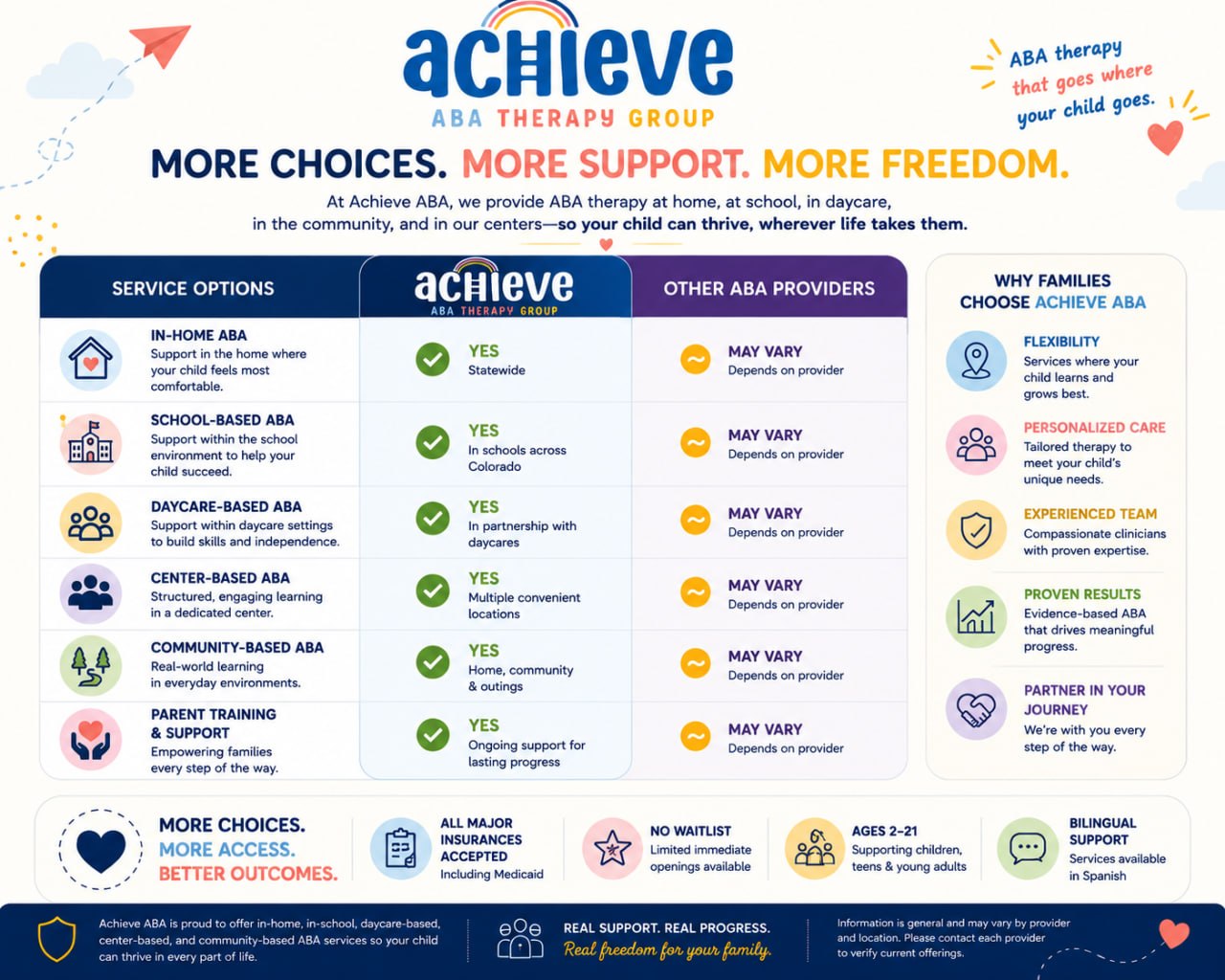
A Visual Guide to More Choices, More Support, More Freedom
ABA Support Across Colorado Communities
We serve families across Colorado communities and bring care into the environments that matter to each treatment plan. Families can learn more about local support in Denver, Aurora, Colorado Springs, Lakewood, Fort Collins, and Pueblo.
We also support families in Thornton, Arvada, Westminster, Centennial, and Boulder, along with additional areas across the state.
Finding the Right Starting Point for Your Family
If you are still at the beginning of the process, our autism evaluation and diagnosis resources can help you understand possible next steps. Once services are appropriate, our team can explain which settings fit the treatment plan and what coordination is possible in your area.
More Choices. More Support. More Freedom.
Choosing an ABA provider is a personal decision, and there is no single setting that is automatically right for every child. What matters is finding a team that can explain its options clearly, connect therapy to meaningful everyday goals, and adapt support as your child’s needs change.
That is the idea behind more choices, more support, and more freedom. At Achieve ABA Therapy Group, we want families to have a care plan that fits real life, not the other way around. Explore our full range of ABA services or reach out to talk through the settings that may be appropriate for your child.
Ready to take the next step? Schedule a consultation with our team or verify your insurance benefits. We can help you understand coverage, service availability, and what getting started may look like in your community.
FAQs
1. What are flexible ABA services?
Flexible ABA services allow therapy to take place across different environments based on a child’s needs, such as at home, school, daycare, in the community, or in a center. This can make it easier to work on skills where they are most likely to be used.
2. How does in-home ABA therapy help children?
In-home ABA therapy gives children the opportunity to build skills within familiar routines and surroundings. It can be especially helpful for areas such as communication, independence, transitions, self-care, and family routines.
3. What is the benefit of school-based or daycare-based ABA therapy?
School-based ABA therapy and daycare-based ABA therapy can support children in environments where they interact with teachers, caregivers, and peers. Working on skills in these settings can help children practice communication, participation, social skills, and daily routines in real time.
4. Why is ABA therapy in multiple settings important?
Practicing skills across different environments can help children learn to use those skills beyond a single therapy session. This process, known as generalization, can support more consistent progress across home, school, daycare, and community life.
5. How do I choose the right ABA provider for my child?
Look for a provider that offers personalized care, involves parents and caregivers, and can adapt services to your child’s everyday environments. It can also be helpful to ask which settings are available in your area, how treatment goals are developed, and how the care team supports progress across routines.