

Autism chores can build real independence, but many families end up repeating the same reminder every day. Teaching a chore well means planning how your help will fade from the very first lesson.
At Achieve ABA Therapy Group, we show Colorado parents how to do exactly that, using the same teaching tools our BCBAs use across the ABA services we offer.
Why Autism Chores Call for a Different Approach
Chores look simple from the outside, but each one is a chain of skills: start, sequence, persist, finish. Many autistic children can do every step and still wait to be told, which points to how the skill was taught.
Executive Function and Multi-Step Tasks
Starting a task, holding the steps in mind, shifting between them, and knowing when you are done all draw on executive function skills, which are often harder for autistic children. Our post on executive dysfunction explains why everyday tasks can feel so hard.
Breaking the task into visible, teachable steps usually helps more than adding reminders.
How Prompt Dependence Develops
A prompt is any help you add so your child succeeds, such as a spoken cue or a gesture. When the same cue comes before every step, the cue becomes part of the routine, and your child learns to wait for it.
This is called prompt dependence, and it grows quietly out of good intentions. Our post on prompt fading explains how therapists step back so a child can do it alone.
What Chores Teach Beyond a Clean Room
A systematic review of 42 studies of youth with autism or intellectual disability aged 13 to 24 describes independent living skills as crucial for post-school success, and cooking and cleaning were the skills taught most often. Starting early gives children years of practice.
Chores also build routines, confidence, and a sense of contributing to the family.
Choosing the Right First Chores
The best first chore is one your child can nearly do already and one that happens naturally in your household. Early wins build the momentum harder chores need.
Start Close to What Your Child Can Already Do
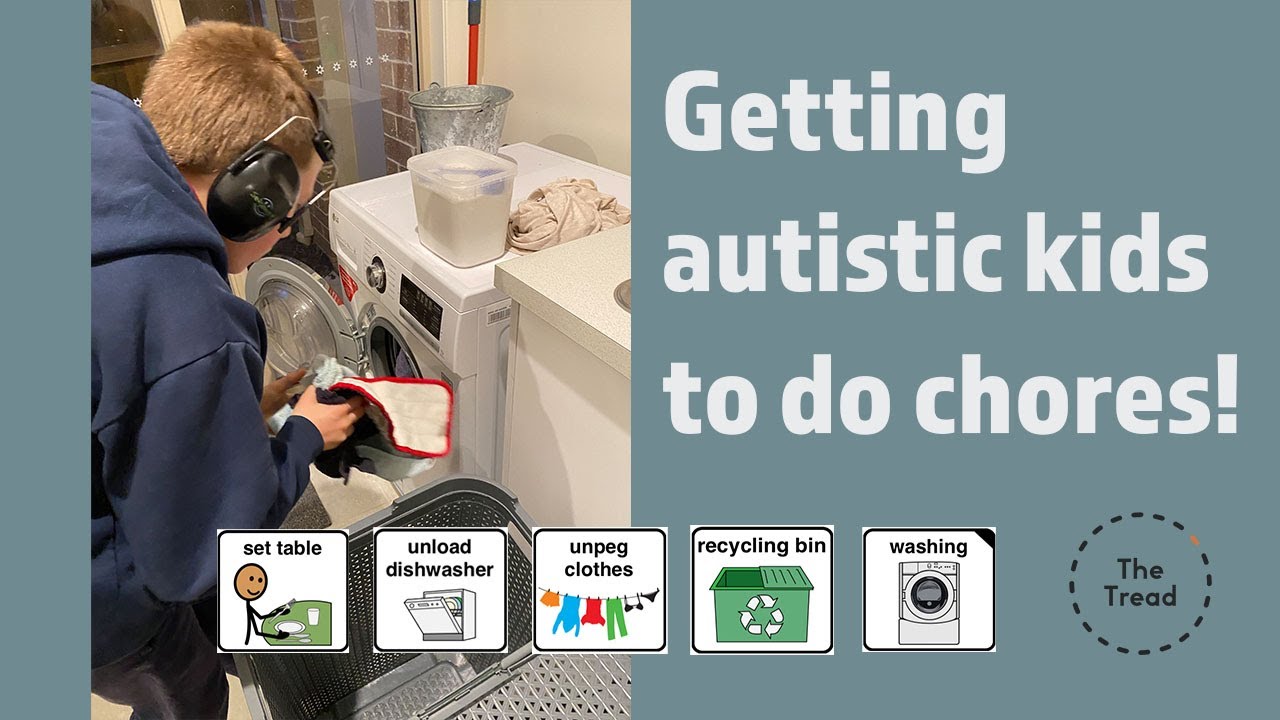
Watch your child for a few days and notice what they already do without being directed: carrying a plate, tossing a wrapper, wiping a spill. Pick one of those and build on it.
A skill your child nearly has keeps frustration low and success high.
Age-Based Chore Ideas
Treat these as loose guides. Readiness, attention, motor skills, and sensory comfort count for more than age.
- Ages 3–5: put toys in a bin, place dirty clothes in a hamper, carry a plate to the sink, wipe a table, scoop pet food
- Ages 6–8: set the table, make the bed, sort laundry by color, load silverware into the dishwasher, water plants
- Ages 9–12: fold and put away laundry, empty the dishwasher, sweep, pack a lunch, take out the trash
- Teens: run a full laundry cycle, prepare a simple meal, clean a bathroom, follow a weekly chore list
Tie Chores to Real Colorado Routines
Chores stick when they connect to something real. In Denver, households use a trash cart, a purple recycling cart, and in many areas a green compost cart, with weekly collection. That makes rolling carts to the curb and sorting recycling natural jobs with a clear start and finish.
Many children enjoy the categorizing involved in sorting paper, plastic, and food scraps. After a snowstorm, a step card showing where to start shoveling and when to stop can turn a family task into a teachable routine.
Breaking Chores Into Steps With Task Analysis
Task analysis is the heart of teaching a chore. It means writing the chore as a short list of small, observable steps your child can learn one at a time.
Write the Task Analysis
Do the chore yourself and write down each action as you go. Each step should be something you can see, such as “pick up the shirt” or “press start,” instead of something vague like “clean up.” Aim for five to ten steps, and adjust as you learn where your child stumbles.
Here is an example for putting dirty clothes in the hamper:
- Pick up the shirt
- Carry it to the hamper
- Lift the lid
- Drop the shirt inside
- Close the lid
Forward, Backward, or Total Task
Behavior analysts call teaching steps in order “chaining,” and there are three common ways to do it:
- Forward chaining: your child learns the first step while you complete the rest, then you add steps one at a time
- Backward chaining: you complete everything except the last step, so your child finishes the chore and earns reinforcement right at the end
- Total task: your child practices every step each time, with prompts matched to what each step needs
Backward chaining is popular because every attempt ends in success. Your child’s BCBA can help choose the method that fits.
Visual Supports and Video Modeling
The 2020 NCAEP review from UNC’s Frank Porter Graham Child Development Institute identified 28 evidence-based practices for autistic learners, including prompting, task analysis, video modeling, and visual support.
A review of daily living interventions found that video modeling met evidence standards (Hong et al., 2016), and another review found video prompting an effective way to teach daily living skills (Gardner & Wolfe, 2013). At home, this can mean a photo checklist, a short phone video of a parent or sibling doing the steps, or a first/then board.
Fading Prompts So Your Child Works Independently
Teaching a chore has two jobs: getting your child to do it, then getting your child to do it without you. Plan the second job from day one.
Use the Least Help That Works
Prompts run from most to least support: hand-over-hand help, partial physical help, modeling, gestures, spoken cues, and visual cues. Start with the lowest level that gets a correct response, then move to a lighter level as your child improves. Our post on prompting levels describes each level in detail.
Give Wait Time Before You Help
After the chore begins, pause and give your child a chance to start or continue before you prompt. Count silently to five. That brief wait is often the first step toward independence.
Replace Your Voice With Visuals and Timers
A checklist on the wall, a timer, and a first/then card do the job of your reminders without the nagging tone. Then thin those out too: move from a full checklist to a few key pictures, and later to a single start cue.
Reinforcement That Fits
Specific praise, a favorite activity after the chore, or a simple chart can all work. Our post on token economies explains how reward charts are built and faded.
Make the reward predictable and quick at first, then thin it gradually so natural outcomes, like a clean table before dinner, begin to carry the routine.
When Chores Do Not Go Smoothly
Hard days are part of learning, and they give you useful information. A few adjustments solve most roadblocks.
Refusal and Escape-Maintained Behavior
If your child protests or melts down when a chore starts, the chore may feel too long, too hard, or too unclear. Shorten it, offer a choice about when or how, and make the first step one your child can do easily. Reinforce effort before you ask for more.
If throwing, hitting, or breaking things becomes part of the pattern, ask your BCBA for a functional behavior assessment.
Sensory Barriers
Vacuum noise, cleaning product smells, wet textures, and sticky surfaces can make a chore feel unbearable. Gloves, unscented products, ear protection, or a different tool can remove the barrier without removing the chore.
Practicing Across People and Places
Skills learned at home may not show up at a grandparent’s house or at school. Practice with different people, rooms, and materials, and share your task analysis and visuals with caregivers so everyone uses the same steps.
Chores for Teens and Young Adults
Chore skills become life skills as children grow, and Colorado builds planning for that into the school system. Starting early gives teens a head start.
Transition Planning in Colorado
In Colorado, a student’s IEP includes a transition plan by age 15 or the end of ninth grade, with measurable post-school goals that can cover independent living skills where appropriate. The state’s Division of Vocational Rehabilitation also works with students with disabilities beginning at age 14.
Bring your child’s chore progress to the IEP meeting so goals reflect what they can already do. Our post on ABA for teens describes how support shifts in the teen years.
Skills That Carry Into Work and Adult Living
Laundry, meal preparation, cleaning with a checklist, and keeping a schedule are the same skills that support jobs and independent or supported living. For individuals who live in group homes, our group home ABA teams build consistent routines with staff so chore skills continue in the home.
How Achieve ABA Helps With Autism Chores
Our teams teach chores where they happen, in the routines of your day, and we coach you to carry the same steps forward when we are not there.
Teaching Chores in Everyday Routines
In-home therapy lets us work on morning, after-school, and bedtime routines in your own kitchen and laundry room. Parent training shows you how to use task analysis and prompt fading between sessions.
Other options fit different seasons and settings:
- Summer ABA gives children time to build routines during school breaks
- In-school ABA and daycare routines extend practice to where children spend their days
- Early intervention programs start with simple tidy-up routines for young children
- Weekend scheduling works for families who need Saturday or Sunday sessions
If you are still looking for answers about your child’s learning profile, a diagnostic evaluation is a good place to begin.
Where We Serve Families
We provide in-home services in Thornton, Westminster, Arvada, Lakewood, and Broomfield, and along the northern Front Range in Boulder, Longmont, Loveland, Fort Collins, and Greeley.
Families in Douglas County can reach us in Parker and Castle Rock, and we also serve Grand Junction on the Western Slope. Browse every community on our locations page.
Building Independence Through Autism Chores
Autism chores work best when the plan for fading your help starts on the first day, and when the chore fits real life in your home.
A Five-Step Starting Routine
- Pick one chore your child can nearly do already.
- Write the steps as five to ten observable actions.
- Add a visual, such as a photo checklist or short video.
- Teach with the least help that works, pause before prompting, and fade cues as your child improves.
- Reinforce and track so you can see progress and adjust.
Talk With Our Colorado Team
If you would like a plan built around your child, we are ready to help. Complete our intake form, or contact us, and we will talk through your goals and your insurance options.
Autism Chores FAQs
These questions come up often when families start working on chores.
What age should I start teaching chores to an autistic child?
Many children can begin with simple tasks like putting toys away in the preschool years, but readiness counts more than age. Begin with a task your child nearly does already and build from there.
What if my child only does chores when I remind them?
That usually points to prompt dependence. Break the chore into steps, add a visual checklist, wait a few seconds before helping, and fade your cues gradually. A BCBA can tailor the plan to your child.
Should I use rewards for chores?
Rewards can help while a skill is new. Choose reinforcers your child likes, deliver them quickly, and thin them over time so the routine can run on its own. Some families link chores to an allowance and others keep the two separate, and either can work if you stay consistent.
What should I do if chores lead to meltdowns?
Shorten the task, lower the demand, add choices, and reinforce small wins. If meltdowns continue or include aggression or property destruction, ask a BCBA for a functional behavior assessment.
Sources:
- City and County of Denver. (n.d.). Trash service. https://www.denvergov.org/Government/Agencies-Departments-Offices/Agencies-Departments-Offices-Directory/Recycle-Compost-Trash/Trash
- Colorado Department of Education. (n.d.). Legal essentials for secondary transition planning in Colorado. https://ed.cde.state.co.us/fs/pages/2201
- Colorado Division of Vocational Rehabilitation. (n.d.). Division of Vocational Rehabilitation. https://dvr.colorado.gov/
- Disability Law Colorado. (2021). Transition services series: The transition process. https://disabilitylawco.org/sites/default/files/uploads/Transition%20Services%20Series%20-%20The%20Transition%20Process%20Booklet%209.27.21.pdf
- Gardner, S., & Wolfe, P. (2013). Use of video modeling and video prompting interventions for teaching daily living skills to individuals with autism spectrum disorders: A review. Research and Practice for Persons with Severe Disabilities, 38(2), 73–87. https://pure.psu.edu/en/publications/use-of-video-modeling-and-video-prompting-interventions-for-teach/
- Hong, E. R., Ganz, J. B., Mason, R., Morin, K., Davis, J. L., Ninci, J., Neely, L. C., Boles, M. B., & Gilliland, W. D. (2016). An evaluation of the quality of research on evidence-based practices for daily living skills for individuals with autism spectrum disorder. Journal of Autism and Developmental Disorders, 46(2), 532–545. https://doi.org/10.1007/s10803-015-2444-3
- Steinbrenner, J. R., Hume, K., Odom, S. L., Morin, K. L., Nowell, S. W., Tomaszewski, B., Szendrey, S., McIntyre, N. S., Yücesoy-Özkan, S., & Savage, M. N. (2020). Evidence-based practices for children, youth, and young adults with autism. University of North Carolina at Chapel Hill, Frank Porter Graham Child Development Institute, National Clearinghouse on Autism Evidence and Practice. https://ncaep.fpg.unc.edu/
- Taconet, A. V., Lombardi, A. R., Madaus, J. W., Sinclair, T. E., Rifenbark, G. G., Morningstar, M. E., & Langdon, S. N. (2023). Interventions focused on independent living skills for youth with intellectual disability or autism spectrum disorder. Career Development and Transition for Exceptional Individuals. https://doi.org/10.1177/21651434231152200
Clinically reviewed by a Board Certified Behavior Analyst at Achieve ABA Therapy Group. Last updated October 2026.